Intention to continue using an AI-integrated online English learning platform: empirical evidence from Vietnam
Abstract
The rapid growth of AI-integrated online English learning platforms, particularly those operating under subscription-based business models, has created an urgent need to understand why learners continue to use these platforms after the initial trial period. Accordingly, this study examines the determinants of learners’ continuance intention to engage in online English learning via AI-integrated platforms. A cross-sectional survey design was employed, yielding 721 observations from learners who had used and/or were currently using AI-integrated online English learning platforms. Structural equation modeling was applied to test the research hypotheses. The results indicate that the proposed model demonstrates a good fit to the data and that the hypothesized relationships are statistically significant. Specifically, performance expectancy, effort expectancy, and social influence positively affect continuance intention. Facilitating conditions exert both a direct effect on continuance intention and an indirect effect by enhancing satisfaction. Trust in AI positively influences satisfaction, and satisfaction emerges as a key predictor driving learners’ continuance intention to use AI-integrated English learning platforms.
Keywords: AI-integrated platforms, Continuance intention for English learning, Satisfaction, UTAUT
Introduction
Recent advances in artificial intelligence, particularly large language models and chatbots, have transformed educational technology by enabling real time interaction and natural language processing [1]. In foreign language education, AI integrated English learning platforms increasingly function as learning agents, offering personalized pathways, adaptive content, and continuous feedback that enhance learner autonomy and engagement [1, 2].
In Vietnam, rising demand for English proficiency has accelerated the adoption of AI‑integrated online learning following the expansion of digital education during COVID‑19 [3]. However, issues related to feedback reliability, data privacy, and overreliance on AI may undermine user trust, which prior studies identify as crucial for sustained use [4, 5].
Prior studies on AI‑integrated English learning examine continuance intention through technology acceptance [6], post‑adoption evaluations [2], and experiential factors such as flow and satisfaction within integrated online platforms [7]. The literature reveals key gaps. Most studies on AI and ChatGPT in education emphasize initial acceptance rather than continuance. Moreover, while UTAUT explains technology motives, trust in AI is critical for sustained use. In Vietnam, domain‑specific evidence for AI‑integrated English learning remains limited [4], [5, 8].
Building on these gaps, this study empirically tests an extended UTAUT model by integrating satisfaction and trust in AI to explain continuance intention toward AI‑integrated English learning platforms. It advances post‑adoption research by providing empirical evidence from Vietnam and offering actionable insights for sustaining long‑term user engagement [9-18].
Online learning with AI-Integrated english learning platforms
Online learning via AI-integrated English learning platforms can be conceptualized as a form of Internet-based learning in which teaching and learning activities are mediated through digital systems, and further augmented by AI capabilities such as natural language processing, context aware reasoning, and adaptive learning [19]. In this environment, AI not only supports content delivery but also participates in the learning process as an agent capable of providing recommendations, feedback, and adjustments based on learners’ interaction data [19, 20].
Compared with traditional e‑learning, AI‑integrated English learning platforms emphasize dialogic interaction and micro‑level personalization. Prior studies show that interactivity, enjoyment, social influence, and especially trust shape continuance intention [6, 21]. However, risks related to feedback reliability, accountability, data privacy, and overreliance on AI may undermine satisfaction and sustained use if inadequately managed [1, 4, 5].
Continuance intention to learn online via Ai-integrated english learning platforms
Beyond initial adoption explained by TAM, information systems research emphasizes continuance intention as the key post‑adoption outcome, formed through users’ evaluations of perceived benefits and usage experiences over time [21]. In AI‑integrated English learning, continuance intention reflects learners’ willingness to sustain use based on reliable AI feedback and positive learning experiences that support motivation and reduce risks of inaccurate outputs [1, 4, 5].
Theoretical foundations
UTAUT is widely applied in online learning to explain system use through performance expectancy, effort expectancy, social influence, and facilitating conditions, although their effects vary across contexts, learner groups, and platform types [22]. While UTAUT mainly explains usage intention, continuance intention reflects post‑adoption decisions based on experienced benefits, usage evaluations, and satisfaction; therefore, this study extends UTAUT by incorporating trust in AI and satisfaction [21].
Research hypotheses and conceptual model
Performance expectancy reflects beliefs that AI‑integrated platforms enhance English proficiency, efficiency, timely feedback, and goal‑aligned practice; thus, higher perceived benefits drive learners’ continuance intention in online learning contexts [22-30]. Evidence from online learning research indicates that PE is a strong predictor of learner’s intention to continue participating in or using digital learning systems. For example, UTAUT based studies in MOOC settings report a significant effect of PE on continued intention [31, 32]. In AI supported language learning contexts, recent findings similarly suggest that learners tend to sustain use when they perceive that AI generates tangible learning value through feedback, recommendations, and skill practice support [33]. On this basis, the following hypothesis is proposed.
H1: Performance expectancy positively influences learners’ continuance intention to learn online via AI-integrated English learning platforms.
Effort expectancy reflects perceived ease of using AI‑integrated platforms; lower usage effort reduces anxiety, enhances control, and directly strengthens learners’ continuance intention in online and AI‑supported English learning contexts [22, 31-33].
H2: Effort expectancy positively influences learners’ continuance intention to learn online via AI-integrated English learning platforms.
Social influence reflects perceived expectations and encouragement from important others, shaping continuance intention through subjective norms, peer and instructor recommendations, and widespread AI adoption within learning communities [22, 31-33].
H3: Social influence positively influences learners’ continuance intention to learn online via AI-integrated English learning platforms.
Facilitating conditions refer to the availability of adequate resources and technical support enabling AI‑integrated English learning, directly or indirectly shaping continuance intention through sustained system use and satisfaction [22, 31, 32].
H4: Facilitating conditions positively influence learners’ continuance intention to learn online via AI-integrated English learning platforms.
Satisfaction represents users’ overall affective evaluation of system use, shaped by perceived usefulness and effectiveness [34]. In online and AI‑supported learning, facilitating conditions—such as digital competence, infrastructure, technical support, and learning resources—consistently enhance learner satisfaction and positive usage experiences [1, 35, 36].
H5: Facilitating conditions positively influence learners’ satisfaction with online English learning on AI-integrated platforms.
In AI‑integrated English learning platforms, learners rely heavily on generative outputs, making trust in AI a pivotal evaluation regulating acceptance and continued use. Higher trust enhances satisfaction and sustained interaction, whereas low trust increases perceived risk and discontinuance, as evidenced in AI chatbot contexts [4, 37, 38].
H6: Trust in AI positively influences learners’ satisfaction with online English learning on AI-integrated platforms.
In post‑adoption information systems research, continuance intention is shaped by users’ experienced value, with satisfaction acting as a key mechanism reflecting expectation confirmation and perceived benefits [21, 39]. In AI‑integrated language learning, satisfaction is particularly salient, as learners evaluate both learning utility and AI‑mediated interaction quality, which strengthens continuance intention [1].
H7: Learner satisfaction positively influences continuance intention to learn English online on AI-integrated platforms.
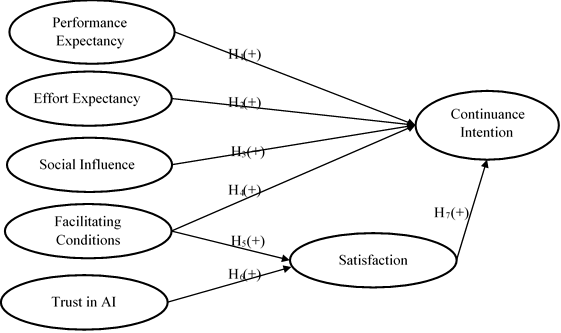
Based on UTAUT and findings from prior studies, we develop a model of learners continuance intention to learn English online via AI-integrated platforms. Figure 1 presents the proposed research model and the study hypotheses.
|
|
|
Figure 1. Proposed Research Model |
Materials and Methods
Measurement scales
A questionnaire‑based survey was used to collect cross‑sectional data for hypothesis testing and generalizability [40]. The instrument comprised demographic items and validated measures of UTAUT constructs, trust in AI, satisfaction, and continuance intention, adapted from prior studies and assessed on a five‑point Likert scale.
Data
The survey was administered online and offline using convenience sampling among learners who had used paid AI‑integrated English learning platforms. Following sample size guidelines suggested by Hair et al. [41], 795 responses were collected; after screening, 721 valid questionnaires were retained for analysis.
Results and Discussion
Scale reliability and validity
Confirmatory factor analysis was conducted to assess the goodness of fit of the measurement model. The results indicated that the model exhibited a good fit to the data: χ² = 545.267; df = 303; p = 0.000; χ²/df = 1.800; GFI = 0.947; TLI = 0.969; CFI = 0.973; RMSEA = 0.033. These indices met commonly recommended thresholds, thereby confirming that the measurement model was acceptable for subsequent analyses [42].
Next, indicator reliability was evaluated using standardized factor loadings. As shown in Table 1, observed variables with factor loadings below acceptable cut off values were removed from the model, including PE1, SI5, TA3, TA5, and US5. After refinement, the remaining indicators exhibited acceptable standardized loadings, with the lowest being FC4 = 0.524 in the CFA results, while the others ranged up to approximately 0.855. Overall, the satisfactory factor loadings suggest that the retained indicators adequately represented the latent constructs in the model [41].
|
Table 1. Factor Loadings of Observed Variables |
|||
|
items |
CFA |
SEM |
|
|
Performance Expectancy (adapted from Thomas et al. [43]; Khechine et al. [44]) |
PE1. I find that an AI-integrated online English learning platform helps me acquire more knowledge and skills in learning English |
Deleted |
Deleted |
|
PE2. Using an AI-integrated online English learning platform enables me to be flexible in scheduling my study time |
0.736 |
0.734 |
|
|
PE3. Using an AI-integrated online English learning platform helps me complete English learning exercises and activities more quickly |
0.741 |
0.741 |
|
|
PE4. Using an AI-integrated online English learning platform helps me be more proactive in English learning activities |
0.819 |
0.82 |
|
|
Effort Expectancy (adapted from Khechine et al. [44]; Thomas et al. [43]) |
EE1. It is easy for me to log in to an AI-integrated online English learning platform |
0.855 |
0.853 |
|
EE2. I can easily learn how to use the AI tools and features on the platform |
0.738 |
0.738 |
|
|
EE3. I find an AI-integrated online English learning platform easy to use |
0.784 |
0.785 |
|
|
EE4. I do not experience difficulty when using an AI-integrated online English learning platform |
0.676 |
0.677 |
|
|
Social Influence (adapted from Khechine et al. [44]; Thomas et al. [43]) |
SI1. People who influence me, such as my parents and friends, think that I should use online courses |
0.685 |
0.683 |
|
SI2. I consider using an AI-integrated online English learning platform to be a modern and widely adopted way of learning |
0.783 |
0.782 |
|
|
SI3. Most of my friends and classmates have used online English learning platforms, particularly those with AI integration |
0.808 |
0.811 |
|
|
SI4. My instructors use online English learning platforms and AI-integrated platforms proficiently |
0.805 |
0.803 |
|
|
SI5. Using an AI-integrated online English learning platform makes me feel that I am participating in an English learning community |
Deleted |
Deleted |
|
|
Facilitating Conditions (adapted from Khechine et al. [44]; Thomas et al. [43]) |
FC1. The AI-integrated online English learning platform is simple and easy to use |
0.815 |
0.804 |
|
FC2. I have sufficient resources, such as a smartphone or computer, headphones, and internet access, to learn English on an AI-integrated platform |
0.846 |
0.798 |
|
|
FC3. I possess the necessary technological skills to learn English on an AI-integrated platform |
0.764 |
0.751 |
|
|
FC4. The AI-integrated online English learning platform is compatible with other learning resources that I use, such as dictionaries, the learning management system, and learning materials |
0.524 |
0.652 |
|
|
FC5. The platform’s technical support and customer service are readily available to assist me when I encounter problems during learning. |
0.654 |
0.508 |
|
|
Trust in AI (adapted from Gulati et al. [45]) |
TA1. I believe that the AI on the platform will act in my best interest when I learn English |
0.765 |
0.759 |
|
TA2. I believe that the AI on the platform will make its best effort to support me when I need help, such as providing explanations, suggestions, or feedback |
0.76 |
0.763 |
|
|
TA3. I believe that the AI on the platform has the capability to function effectively in its tasks, such as providing learning recommendations, practice activities, and feedback |
Deleted |
Deleted |
|
|
TA4. If I use the AI on the platform, I feel that I can rely on it in a trustworthy manner when learning English |
0.775 |
0.774 |
|
|
TA5. I trust the information and feedback provided by the AI on the platform when I learn English |
Xóa |
Xóa |
|
|
User Satisfaction (adapted from Dağhan & Akkoyunlu [46]) |
US1. I am satisfied with the AI enabled features provided by the online English learning platform. |
0.738 |
0.734 |
|
US2. I am satisfied with the English learning content provided by the platform |
0.811 |
0.807 |
|
|
US3. I am satisfied with the quality of the AI-integrated online English learning platform or course |
0.778 |
0.783 |
|
|
US4. I am satisfied with the services provided by the AI-integrated online English learning platform that I use |
0.691 |
0.693 |
|
|
US5. The AI-integrated online English learning platform or course meets the English learning objectives and expected learning outcomes that I pursue. |
Deleted |
Deleted |
|
|
Continuance Intention (adapted from Guo et al. [47]; Wu & Chen [48]) |
YCI1. If given the opportunity, I will continue learning English on an AI-integrated online platform as part of my learning program or study plan |
0.805 |
0.8 |
|
YCI2. I will continue learning English on an AI-integrated online platform to enhance my English knowledge and skills. |
0.762 |
0.755 |
|
|
YCI3. I will recommend this AI-integrated online English learning platform to others |
0.802 |
0.797 |
|
|
YCI4. I intend to continue learning English on an AI-integrated online platform through other courses or programs |
0.785 |
0.778 |
|
Scale reliability was assessed using Cronbach’s alpha (α) and composite reliability (CR). As reported in Table 2, Cronbach’s alpha ranged from 0.806 to 0.868, and CR ranged from 0.811 to 0.868. All values exceeded the 0.70 threshold, indicating good internal consistency of the measurement scales [49]. Convergent validity was examined using the average variance extracted (AVE). The results in Table 2 show that the AVE values for all constructs were greater than 0.50, ranging from 0.508 to 0.622. This provides evidence that the scales achieved adequate convergent validity.
|
Table 2. Scale validity |
||||||||||
|
Concept |
α |
CR |
AVE |
SI |
EE |
PE |
FC |
TA |
YCI |
US |
|
SI |
0.852 |
0.854 |
0.595 |
0.772 |
||||||
|
EE |
0.847 |
0.849 |
0.587 |
0.424 |
0.766 |
|||||
|
PE |
0.806 |
0.81 |
0.587 |
0.409 |
0.248 |
0.766 |
||||
|
FC |
0.828 |
0.834 |
0.508 |
0.349 |
0.264 |
0.505 |
0.713 |
|||
|
TA |
0.811 |
0.811 |
0.588 |
0.434 |
0.231 |
0.389 |
0.414 |
0.767 |
||
|
YCI |
0.868 |
0.868 |
0.622 |
0.449 |
0.399 |
0.522 |
0.476 |
0.385 |
0.789 |
|
|
US |
0.839 |
0.841 |
0.571 |
0.458 |
0.273 |
0.455 |
0.459 |
0.318 |
0.602 |
0.756 |
Discriminant validity was assessed using the Fornell and Larcker criterion by comparing the square root of the AVE values (the bold diagonal entries in Table 2) with the inter construct correlations. The results indicate that the square root of AVE for each construct was greater than its corresponding correlations with other constructs. Therefore, the measurement model demonstrates adequate discriminant validity, confirming that the study constructs are distinct and not excessively overlapping.
Hypothesis testing
Structural equation modeling was employed to test the research hypotheses. The fit indices of the structural model indicated a good fit to the data: χ² = 618.427; df = 307; p = 0.000; χ²/df = 2.014; GFI = 0.940; TLI = 0.960; CFI = 0.965; RMSEA = 0.038. These values meet commonly recommended thresholds and suggest that the structural model demonstrates an acceptable level of fit, consistent with the guidelines proposed by Kline [42].
Next, the path estimates are reported in Figure 2 and Table 3. Specifically, performance expectancy exerted a positive and statistically significant effect on continuance intention (β = 0.236, p = 0.000 < 0.01), and effort expectancy also showed a significant positive effect (β = 0.187, p = 0.000 < 0.01). In addition, social influence had a positive effect on continuance intention at the 5 percent significance level (β = 0.088, p = 0.039 < 0.05). Accordingly, hypotheses H1, H2, and H3 were supported.
|
|
|
Figure 2. Hypothesis testing results |
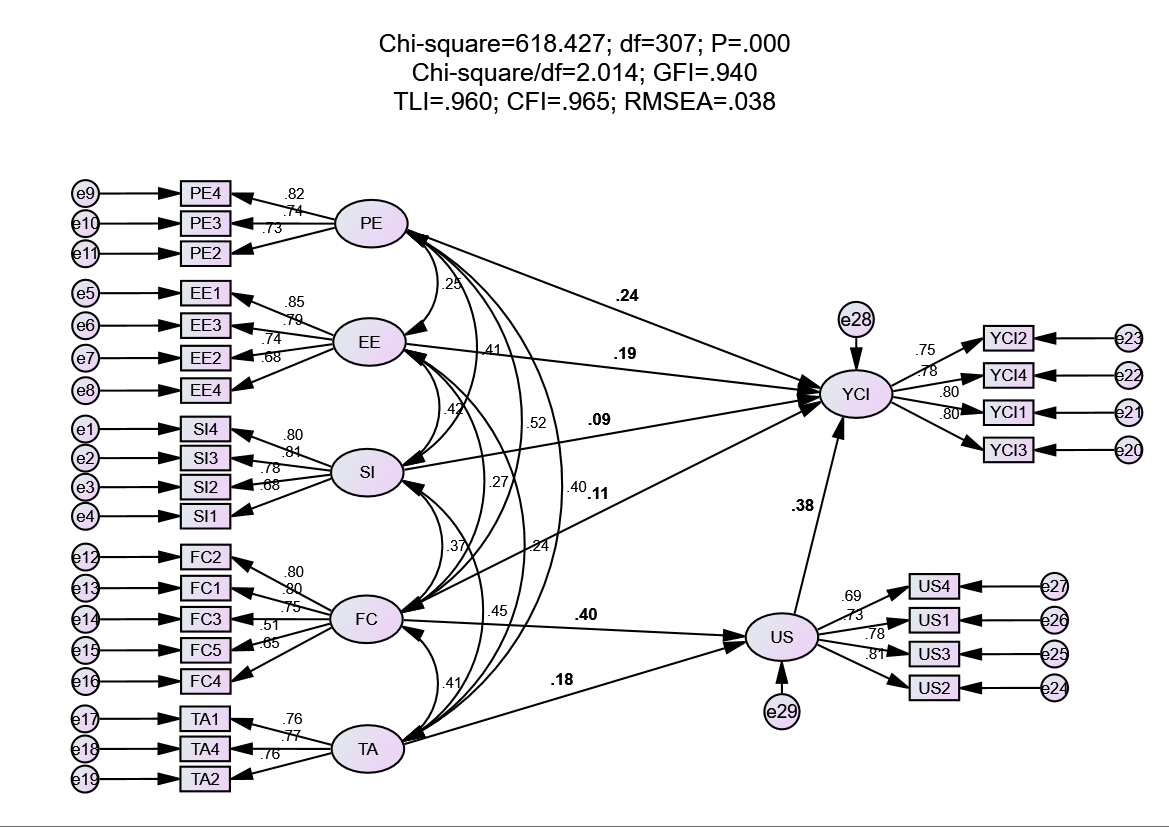
With respect to facilitating conditions, the results indicate that this construct had a positive direct effect on continuance intention (β = 0.114, p = 0.020 < 0.05); therefore, H4 was supported. Facilitating conditions also exerted a significant positive influence on user satisfaction (β = 0.404, p = 0.000 < 0.01), supporting H5. In addition, trust in AI had a significant positive effect on user satisfaction (β = 0.184, p = 0.000 < 0.01); thus, H6 was supported. Finally, user satisfaction had a strong and significant positive impact on continuance intention (β = 0.375, p = 0.000 < 0.01), confirming H7.
|
Table 3. Results of hypothesis testing |
|||||||
|
H |
Relationship |
Unstandardized coefficient |
Standardized coefficient |
p-value |
Result |
||
|
H1 |
Performance Expectancy |
→ |
Continuance Intention |
0.233 |
0.236 |
0.000 |
Yes |
|
H2 |
Effort Expectancy |
→ |
Continuance Intention |
0.175 |
0.187 |
0.000 |
Yes |
|
H3 |
Social Influence |
→ |
Continuance Intention |
0.088 |
0.088 |
0.039 |
Yes |
|
H4 |
Facilitating Conditions |
→ |
Continuance Intention |
0.108 |
0.114 |
0.020 |
Yes |
|
H5 |
Facilitating Conditions |
→ |
Satisfaction |
0.418 |
0.404 |
0.000 |
Yes |
|
H6 |
Trust in AI |
→ |
Satisfaction |
0.184 |
0.184 |
0.000 |
Yes |
|
H7 |
Satisfaction |
→ |
Continuance Intention |
0.345 |
0.375 |
0.000 |
Yes |
Overall, Table 3 indicates that the regression coefficients, including both unstandardized and standardized estimates, for the hypothesized relationships in the model are statistically significant at a minimum 95 percent confidence level. This result provides empirical support for all research hypotheses tested in the model.
The results indicate that performance expectancy has a significant positive effect on continuance intention (β = 0.236; p < 0.01), suggesting that learners are more likely to sustain usage when they perceive clear learning benefits, such as improved proficiency and more efficient or accurate feedback. This finding is consistent with the central role of performance expectancy in shaping behavioral intention and aligns with prior online learning studies identifying it as a strong predictor of continuance intention [22, 32, 50, 51]. In AI enabled learning contexts, performance expectancy additionally reflects the cognitive quality and perceived value of AI generated feedback.
Effort expectancy also positively influences continuance intention (β = 0.187; p < 0.01), confirming that perceived ease of use encourages sustained engagement [32, 50]. In AI mediated environments, effort expectancy extends beyond interface usability to encompass the interaction cost of collaborating with AI, including formulating prompts and interpreting outputs.
Social influence shows a weaker but significant effect on continuance intention (β = 0.088; p < 0.05), indicating that while peers and instructors remain relevant, continued use is driven primarily by learners’ personal experience [32, 51].
Facilitating conditions exert both a direct effect on continuance intention (β = 0.114; p < 0.05) and a strong effect on satisfaction (β = 0.404; p < 0.01), underscoring the importance of reliable infrastructure and technical support [32].
Finally, trust in AI enhances satisfaction (β = 0.184; p < 0.01), and satisfaction strongly predicts continuance intention (β = 0.375; p < 0.01), supporting post acceptance theory [32, 38, 52].
Theoretical implications
This study contributes to post adoption research in educational technology by examining the determinants of learners’ continuance intention toward AI integrated English learning platforms [53-62]. Unlike prior studies that mainly emphasize initial adoption or technology readiness, this study focuses on the continuance stage after learners have gained direct experience with AI functionalities. This perspective clarifies how sustained use in AI enabled learning depends not only on online delivery but also on the quality of learner–AI interaction.
The findings confirm that core UTAUT constructs—performance expectancy, effort expectancy, and social influence—remain significant predictors of continuance intention in AI integrated English learning. However, their meanings extend beyond traditional interpretations. Performance expectancy reflects not only learning convenience but also AI generated value, such as improved language output, error reduction, accelerated practice, and goal aligned support. Effort expectancy captures both system usability and the cognitive effort involved in interacting with AI, including formulating requests, interpreting feedback, and applying outputs to learning tasks. These results indicate that while UTAUT retains its structural logic, its constructs require contextual reinterpretation in AI enabled learning environments.
Moreover, the study highlights satisfaction as a central mechanism linking usage experience to continuance intention. In AI contexts, satisfaction encompasses perceptions of feedback quality, appropriateness, consistency, and explainability. Finally, trust in AI emerges as a key antecedent of satisfaction by reducing perceived uncertainty and risk, thereby reinforcing learners’ intention to continue using AI integrated English learning platforms.
Managerial implications
The findings provide clear managerial implications for AI integrated English learning platform providers. First, strengthening performance expectancy is critical for long term user retention. Platforms should prioritize high quality, proficiency aligned AI feedback and make learning progress visible through personalized pathways and skill based indicators. Demonstrating tangible learning gains encourages sustained use.
Second, effort expectancy remains a key driver of continuance intention. Providers should minimize interaction complexity by optimizing cross device usability, offering structured prompts, and delivering concise, actionable feedback. Lowering cognitive and operational effort supports habit formation and continued engagement.
Third, while social influence exerts a weaker effect, community based features such as peer practice groups, shared challenges, and progress sharing tools can reinforce continuance intention, particularly during early usage stages. Institutional endorsement and instructor guidance on effective AI use may further strengthen learner confidence.
Fourth, facilitating conditions strongly shape user satisfaction. Ensuring system stability, fast response times, cross platform compatibility, and responsive technical support is essential, as AI mediated learning requires uninterrupted interaction. Transparent account and payment processes further reduce discontinuance risk.
Finally, trust in AI is fundamental to sustaining satisfaction and continuance intention. Platforms should enhance trust through consistent output quality, clear explanatory rationales for AI feedback, and transparent data governance policies. Continuous monitoring of user satisfaction across key touchpoints is essential for long term retention.
Conclusion
This study examined the determinants of learners’ continuance intention to use AI-integrated online English learning platforms in Vietnam by extending the UTAUT model with satisfaction and trust in AI. Based on data from 721 users and structural equation modeling analysis, the findings indicate that performance expectancy, effort expectancy, social influence, and facilitating conditions significantly influence continuance intention. Among these, satisfaction emerges as the strongest predictor of continued use, while facilitating conditions and trust in AI play critical roles in enhancing learner satisfaction.
The results highlight that sustained engagement with AI-integrated English learning platforms depends not only on perceived usefulness and ease of use but also on reliable infrastructure and learners’ confidence in AI-generated feedback. By integrating technology acceptance, post-adoption evaluation, and human–AI relational perspectives, this study contributes to a more comprehensive understanding of continuance behavior in AI-enabled language learning and offers practical insights for designing sustainable AI-integrated learning platforms.
Limitations and future research
The study has several limitations. First, the cross-sectional survey design and reliance on self-reported data may introduce common method bias and fail to capture changes in users’ intention to use over time. Second, the use of a convenience sample in Vietnam limits the generalizability of the findings to other learner groups and to different organizational and educational contexts. Third, because the proposed framework primarily extends UTAUT by incorporating trust and satisfaction, it may not fully account for other salient determinants such as habit, hedonic motivation, and concerns related to risk and privacy. Future research should employ longitudinal designs, broaden the sample by comparing different user groups, and conduct cross-platform comparisons across AI tools. In addition, subsequent studies should further extend the research model to provide a more comprehensive explanation of users’ continuance intention toward AI-integrated platforms.
Acknowledgments: The author would like to express sincere gratitude to the Industrial University of Ho Chi Minh City for supports. Special thanks are also extended to editors and reviewers whose constructive comments and suggestions helped improve the quality of this research.
Conflict of interest: None
Financial support: None
Ethics statement: None
References
- Jiang S, Numtong K, Asavaratana W. Toward sustained interaction: investigating the drivers of continued use of AI chatbots for language learning in Confucius Institutes. Front Educ. 2025;10:1656204.
- Huang F, Zou B. English speaking with artificial intelligence (AI): The roles of enjoyment, willingness to communicate with AI, and innovativeness. Comput Human Behav. 2024;159:108355.
- Thuy T, Tran H. Online learning during the COVID-19 pandemic: A multiperspectival narrative of Vietnamese university students. J Educ Teach Trainers. 2024;15:1-10.
- Afroogh S, Akbari A, Malone E, Kargar M, Alambeigi H. Trust in AI: progress, challenges, and future directions. Humanit Soc Sci Commun. 2024;11(1):1-30.
- Ng SWT, Zhang R. Trust in AI-driven chatbots: A systematic review. Telemat Inform. 2025:102240.
- Ni A, Cheung A. Understanding secondary students’ continuance intention to adopt AI-powered intelligent tutoring system for English learning. Educ Inf Technol. 2023;28(3):3191-216.
- Wu C, Fan W. Students’ flow experience of using AI-powered online English learning platforms. HighTech Innov J. 2024;5(2):382-99.
- Ngo TTA, Phan TYN, Nguyen TK, Le NBT, Nguyen NTA, Le TTD. Understanding continuance intention toward the use of AI chatbots in customer service among generation Z in Vietnam. Acta Psychol (Amst). 2025;259:105468.
- Mitchell J, Howard L. How leader humility influences organizational citizenship behavior through job satisfaction and employee engagement. Ann Organ Cult Leadersh Extern Engagem J. 2024;5:174-86. doi:10.51847/9HkFow5dIc
- Mestdagh B, Liedekerke LV, Sempiga O. Developing a framework for the drivers of positive organizational behavior. Ann Organ Cult Leadersh Extern Engagem J. 2025;6:15-20. doi:10.51847/u0Pms4k4y6
- Hakami A. Pulmonary carcinosarcoma: A rare and poor prognosis cancer–a retrospective analysis. Asian J Curr Res Clin Cancer. 2024;4(1):31-9. doi:10.51847/ANsF5Aosvo
- Fernandez E, Moore MQ. The alternative splicing of CLSTN1 driven by ESRP1 suppresses gastric cancer metastasis. Asian J Curr Res Clin Cancer. 2025;5(1):177-95. doi:10.51847/cZOZ2TW0T4
- Rahman A, Ismail NH, Hassan FZ. Slovenian translation and validation of the European Health Literacy Survey Questionnaire (HLS-EU-Q47). Ann Pharm Pract Pharmacother. 2024;4:184-93. doi:10.51847/9N2mpC5emX
- Bennett SL, Clarke TJ. Measuring medication adherence in online pharmacy settings: Novel applications of the proportion of days covered. Ann Pharm Pract Pharmacother. 2025;5:256-69. doi:10.51847/Bf8Q5kKpOc
- Gonzalez M, Ruiz J, Torres L, Moreno D. QSAR-guided identification of novel triazole derivatives as potent α-glucosidase inhibitors with favorable ADMET profiles. Pharm Sci Drug Des. 2024;4:230-48. doi:10.51847/jluA9dekev
- Watanabe H, Mori A. ED-71 protects against glucocorticoid-triggered osteoporosis by influencing osteoblast differentiation through Notch and Wnt/β-catenin pathways. Pharm Sci Drug Des. 2025;5:1-19. doi:10.51847/aqKnaGGMQB
- Boas GRV, Silveira APSD, Farinelli BCF, Cardoso CAL, Arce E, Oesterreich SA. The antidepressant effects of Melilotus officinalis fruit ethanolic extract: A mouse model study. Spec J Pharmacogn Phytochem Biotechnol. 2024;4:21-8. doi:10.51847/veH0VxtfZi
- Jiménez L, Morales S, Vega A. Caffeine-driven modulation of hepatic lipid metabolism: A network-based gene expression analysis in mice. Spec J Pharmacogn Phytochem Biotechnol. 2025;5:304-9. doi:10.51847/lyqbWcN4Uk
- Holmes W, Bialik M, Fadel C. Artificial intelligence in education: promises and implications for teaching and learning. Center for Curriculum Redesign; 2019.
- Zawacki-Richter O, Marín VI, Bond M, Gouverneur F. Systematic review of research on artificial intelligence applications in higher education–where are the educators? Int J Educ Technol High Educ. 2019;16(1):1-27.
- Bhattacherjee A. Understanding information systems continuance: An expectation-confirmation model. MIS Q. 2001:351-70.
- Venkatesh V, Morris MG, Davis GB, Davis FD. User acceptance of information technology: Toward a unified view. MIS Q. 2003:425-78.
- Pardo-Zamora F, Castellano-Rioja G. Liquid biopsy in oral cancer diagnosis: A narrative review. Arch Int J Cancer Allied Sci. 2024;4(1):1-6. doi:10.51847/CcaLqtzvoN
- Pop AI, Stan RD. EFNB2/EPHB4 axis activation promotes post-metastatic colonization of colorectal cancer in the liver. Arch Int J Cancer Allied Sci. 2025;5(1):179-99. doi:10.51847/Z45KOBSjYh
- Dorji T, Wangchuk P. Ethical considerations in health monitoring within the armed forces: A Dutch case study during COVID-19. Asian J Ethics Health Med. 2024;4:204-14. doi:10.51847/XV2L2pctU9
- Tutticci S, Marian M. Integrating environmental sustainability into clinical decision-making: A systematic review. Asian J Ethics Health Med. 2025;5:79-94. doi:10.51847/oGhDOKCuki
- Sagredo-Olivares K, Bravo PR. FKBP5 gene polymorphisms and insomnia symptoms during depressive episodes. Bull Pioneer Res Med Clin Sci. 2025;5(1):137-51. doi:10.51847/jKltbXlwMc
- Cavero M, Ferraz JP. Sedentary behavior determinants in pregnant women. Bull Pioneer Res Med Clin Sci. 2025;5(1):1-12. doi:10.51847/bdDIEuY7cl
- Bandi V, Dey SK, Rao O. Factors influencing physician prescribing behaviour: A systematic review. J Integr Nurs Palliat Care. 2024;5:21-34. doi:10.51847/ZS3boQgksO
- Hamaideh S, Khait AA, Al-Modallal H, Masa’deh R, Hamdan-Mansour A, AlBashtawy M. Investigating factors in nurses’ professional quality of life: A review. J Integr Nurs Palliat Care. 2025;6:12-7. doi:10.51847/k8xYY6EKKp
- Li Y, Zhao M. A study on the influencing factors of continued intention to use MOOCs: UTAUT model and CCC moderating effect. Front Psychol. 2021;12:528259.
- Wan L, Xie S, Shu A. Toward an understanding of university students’ continued intention to use MOOCs: When UTAUT model meets TTF model. Sage Open. 2020;10(3):2158244020941858.
- Tram NHM, Nguyen TT, Tran CD. ChatGPT as a tool for self-learning English among EFL learners: A multi-methods study. System. 2024;127:103528.
- Lee S. Understanding user experience with computer-based applications with different use purposes. Int J Hum Comput Interact. 2013;29(11):689-701.
- Sahin I, Shelley M. Considering students’ perceptions: The distance education student satisfaction model. J Educ Technol Soc. 2008;11(3):216-23.
- Mohd Nasir FD, Hussain MAM, Mohamed H, Mohd Mokhtar MA, Abdul Karim N. Student satisfaction in using a learning management system (LMS) for blended learning. Asian J Univ Educ. 2021;17(4):442-54.
- Wut TM, Lee SW, Xu J, Kwok MLJ. Do trusting belief and social presence matter? Service satisfaction in using AI chatbots. Informatics. 2025;12(3):91.
- Joshi H. Integrating trust and satisfaction into the UTAUT model to predict chatbot adoption. Int J Inf Manag Data Insights. 2025;5(1):100332.
- Lin WS, Wang CH. Antecedences to continued intentions of adopting e-learning systems. Comput Educ. 2012;58(1):88-99.
- Dooley K. Social research methods. 4th ed. Upper Saddle River (NJ); 2001.
- Hair JF, Black WC, Babin BJ, Anderson RE. Multivariate data analysis. 7th ed. Upper Saddle River (NJ): Pearson; 2010.
- Kline RB. Principles and practice of structural equation modeling. New York: Guilford Press; 2015.
- Thomas T, Singh L, Gaffar K. The utility of the UTAUT model in explaining mobile learning adoption. Int J Educ Dev Using ICT. 2013;9(3).
- Khechine H, Lakhal S, Pascot D, Bytha A. UTAUT model for blended learning. Interdiscip J E-Learning Learn Objects. 2014;10(1):33-52.
- Gulati S, Sousa S, Lamas D. Design and evaluation of a human-computer trust scale. Behav Inf Technol. 2019;38(10):1004-15.
- Dağhan G, Akkoyunlu B. Modeling continuance usage intention of online learning environments. Comput Human Behav. 2016;60:198-211.
- Guo Z, Xiao L, Van Toorn C, Lai Y, Seo C. Promoting online learners’ continuance intention. Inf Manag. 2016;53(2):279-95.
- Wu B, Chen X. Continuance intention to use MOOCs. Comput Human Behav. 2017;67:221-32.
- Nunnally JC, Bernstein IH. Psychological theory. New York: McGraw-Hill; 1994.
- Liu N, Pu Q. Factors influencing learners’ continuance intention toward one-to-one online learning. Interact Learn Environ. 2020:1-22.
- Nordin N, Norman H, Embi MA. Technology acceptance of MOOCs in Malaysia. Malays J Distance Educ. 2015;17(2).
- Cheng YM. A hybrid model for exploring antecedents of cloud ERP continuance. Int J Web Inf Syst. 2018.
- Ricci M, Benedetti C, Moretti G. Efficacy of traditional Chinese medicine nursing interventions. Interdiscip Res Med Sci Spec. 2024;4(1):170-7. doi:10.51847/XnZfRH34w4
- Diallo H, Barry M, Camara I. Recorded lectures as supplementary learning resources. Interdiscip Res Med Sci Spec. 2025;5(2):102-12. doi:10.51847/HWm2uHCPjG
- Formiga MDC, Fuller R, Ardelean LC, Shibli JA. Case report on a 3D-printed CAD-CAM implant abutment. J Curr Res Oral Surg. 2024;4:14-9. doi:10.51847/cBiqiY5b32
- Pardo-Zamora G, Ortiz-Ruíz AJ, Camacho-Alonso F, Martínez-Marco JF, Molina-González JM, Piqué-Clusella N, et al. Innovations in implant dentistry. J Curr Res Oral Surg. 2025;5:33-43. doi:10.51847/PHtKDGy2N7
- Rahman MA, Jahan N. Social capital and informal support in chronic disease care. Int J Soc Psychol Asp Healthc. 2024;4:87-99. doi:10.51847/yXmpmFJ7mS
- Nagesh D, Lam Ip CYT, Li K, Wong HSL, Chai JYH. Navigating support networks. Int J Soc Psychol Asp Healthc. 2025;5:35-48. doi:10.51847/iJoPhqpXaV
- Raju N. Exploring healthcare providers’ views on cognitive assessment. Ann Pharm Educ Saf Public Health Advocacy. 2024;4:29-42. doi:10.51847/OHbxZJ6ejX
- Hassan AR, Farouk SI, Abdelrahman ON. Can virtual microbiology labs achieve comparable outcomes. Ann Pharm Educ Saf Public Health Advocacy. 2025;5:119-28. doi:10.51847/D55RlfgU0q
- Kostadinova M, Raykovska M, Simeonov R, Lolov S, Mourdjeva M. Advancements in bone tissue regeneration. J Med Sci Interdiscip Res. 2024;4(1):8-14. doi:10.51847/9j9DuUUgWY
- Novak TJ, Dvorak PM. A spatiotemporal neural network framework for EEG-based emotion recognition. J Med Sci Interdiscip Res. 2025;5(2):24-38. doi:10.51847/A2pBOYHJW1
How to cite this article:
Citation Formats:
Contact Meral
Meral Publications
www.meralpublisher.com
Davutpasa / Zeytinburnu 34087
Istanbul
Turkey
Email: [email protected]