A systematic review of design and implementation of quality-oriented educational management models in pharmacy education
Abstract
Quality assurance in pharmacy education is increasingly shaped by accreditation expectations, competency-based reform, and institutional accountability. These pressures have encouraged pharmacy schools to adopt more formal educational management models for curriculum design, monitoring, and improvement. Despite a growing body of literature, evidence on the design characteristics, implementation processes, and practical effectiveness of quality-oriented models remains fragmented. Published work often addresses individual tools, standards, or institutional initiatives rather than offering an integrated synthesis. This systematic review aims to synthesize published studies on quality-oriented educational management models in pharmacy education. The review focuses on design principles, implementation pathways, contextual barriers, and reported educational implications. Comprehensive searches of PubMed, ERIC, Scopus, Web of Science, EMBASE, and pharmacy education-specific sources were conceptually framed around quality management, accreditation, curriculum mapping, continuous improvement, and implementation. Eligible literature included peer-reviewed primary studies, reviews, case reports, program descriptions, and conceptual analyses published in English from 2017 to 2025. The synthesis identifies recurring design components such as curriculum alignment, competency mapping, continuous improvement cycles, assessment systems, and stakeholder governance. The literature describes leadership commitment, faculty development, phased implementation, and accreditation alignment as recurring strategies for institutionalizing quality-oriented educational management. A consolidated map of design and implementation knowledge emerges from the reviewed literature. This synthesis offers pharmacy educators and administrators evidence-informed guidance for building, evaluating, and refining educational quality management systems.
Keywords: Quality management, Pharmacy education, Educational management model, Systematic review, Continuous quality improvement, Implementation
Introduction
The expansion and diversification of pharmacy education have increased pressure on institutions to demonstrate systematic management of curriculum quality, assessment coherence, and graduate competence. Recent pharmacy education literature frames quality not only as curricular content, such as quality improvement education, but also as a program-level issue involving how PharmD programs define, measure, and improve educational quality [1, 2]. Competency-based approaches further reinforce the expectation that pharmacy curricula should be organized around explicit outcomes rather than informal assumptions about content coverage [3]. These developments position educational management as a central mechanism through which pharmacy schools align curriculum design, institutional accountability, and professional preparation.
Quality-oriented educational management models in pharmacy education commonly adapt ideas from broader quality assurance, accreditation, continuous improvement, and outcome-based education traditions. In pharmacy programs, these principles are frequently operationalized through competency mapping, assessment systems, accreditation review, and institutional quality processes rather than through direct adoption of a single industrial model [4-6]. Curriculum mapping studies show how quality can be made visible by linking outcomes, educational activities, assessments, institutional mission, and national requirements [4, 7]. Accreditation-focused work similarly shows that external standards often provide the organizing structure through which schools formalize internal quality management [6, 8].
The available evidence is valuable but dispersed across specific domains of pharmacy education, including experiential education, co-curriculum, standardized assessment, curriculum quality surveys, and competency mapping. Studies of experiential quality assurance and co-curricular implementation show that quality management extends beyond didactic coursework into practice-based and developmental learning environments [9, 10]. Work on the Pharmacy Curriculum Outcomes Assessment, high-impact assessment practices, and curriculum quality surveys demonstrates that assessment evidence can support program monitoring when it is embedded within a broader improvement process [11-13]. However, these strands have often been presented as individual tools or institutional initiatives rather than synthesized as components of quality-oriented educational management models.
This review aims to identify, compare, and integrate literature on the design and implementation of quality-oriented educational management models in pharmacy education from 2017 to 2025. It synthesizes studies that address curriculum alignment, competency-based design, assessment systems, stakeholder engagement, continuous improvement, accreditation preparation, and implementation processes [14-17]. The review uses conceptual synthesis rather than statistical aggregation because the literature is primarily descriptive, evaluative, and implementation-oriented. Its purpose is to provide a structured account of how pharmacy schools design, implement, and refine educational quality systems.
Background
Quality movements in higher education and health professions
Quality movements in higher education and health professions education have gradually shifted from episodic compliance review toward continuous, evidence-informed improvement of educational systems. In pharmacy education, this shift is reflected in literature that treats quality improvement as both a curricular responsibility and an institutional management concern [1]. Program-quality scholarship further suggests that educational quality involves multiple dimensions, including curriculum design, outcomes, resources, assessment, governance, and accountability [2]. Accreditation studies show how external review systems translate these broader quality movements into formal expectations for pharmacy programs [6].
The unique context of pharmacy education
Pharmacy education requires quality-management approaches that can integrate scientific foundations, patient-care processes, professional identity formation, experiential learning, and regulatory expectations. Global comparisons of initial pharmacy education demonstrate variation in curricular structures, strengthening the need for frameworks that support coherence and comparability across systems [18]. Studies of prescribing competency mapping and Pharmacist Patient Care Process integration show how pharmacy programs translate professional expectations into curriculum design and assessment priorities [14, 15]. This makes pharmacy education a particularly relevant setting for quality-oriented educational management models that connect competency frameworks with institutional curriculum governance.
Defining “educational management model” in pharmacy
In this review, an educational management model in pharmacy refers to a coordinated system for designing, implementing, monitoring, evaluating, and improving educational quality. The model may include curriculum maps, competency frameworks, quality indicators, assessment structures, stakeholder feedback mechanisms, and governance processes that support continuous improvement [4, 7, 9]. Curriculum quality surveys represent one example of a formal mechanism for collecting and interpreting program-level evidence across institutions [13]. Experiential education quality assurance practices further indicate that educational management must address both classroom-based and practice-based learning environments [9].
Evidence on quality management model effectiveness
Evidence on the effectiveness of quality-oriented educational management models in pharmacy education is mostly descriptive and interpretive rather than experimental. The literature tends to indicate that structured assessment systems, curriculum quality surveys, and standardized program-level assessments can help schools identify curricular strengths, gaps, and areas for improvement [11-13]. These tools appear most useful when they are connected to decision-making processes rather than treated as isolated data-collection exercises [11]. As a result, the evidence supports the practical value of quality-management components while also showing that stronger longitudinal and comparative research remains needed.
Rationale for a systematic review
A systematic review is needed because the literature contains many relevant components of educational quality management but lacks an integrated synthesis focused specifically on pharmacy education. Curriculum mapping, accreditation alignment, experiential quality assurance, co-curriculum implementation, faculty engagement, and competency-based reform are often discussed separately, even though they address related aspects of educational management [4, 9, 10, 16]. Broader reviews of competency-based pharmacy education further show that implementation is complex and shaped by institutional context, professional expectations, and educational design choices [17]. Synthesizing this evidence can help clarify how quality-oriented models are constructed and implemented across pharmacy schools.
Materials and Methods
Review design and reporting approach
This review was designed as a systematic review of peer-reviewed literature on quality-oriented educational management models in pharmacy education published from 1 January 2017 to 31 December 2025. The review followed a structured evidence-synthesis process based on predefined eligibility criteria, reproducible search concepts, staged screening, standardized data extraction, and critical appraisal of included studies. Because the topic includes empirical studies, program descriptions, curriculum mapping reports, accreditation-related analyses, scoping reviews, and conceptual implementation papers, the synthesis used a mixed evidence approach rather than meta-analysis [1, 4, 9, 10, 13, 17]. The review question was: how have quality-oriented educational management models in pharmacy education been designed, implemented, evaluated, and integrated with accreditation, curriculum alignment, continuous improvement, and stakeholder governance?
Search strategy and information sources
The search strategy combined terms related to pharmacy education, quality management, accreditation, curriculum mapping, continuous quality improvement, competency-based education, assessment systems, faculty development, and implementation. Searches were planned for PubMed, ERIC, Scopus, Web of Science, EMBASE, and pharmacy education-specific journal sources, with supplementary hand-searching of reference lists from included papers and relevant pharmacy education journals. Search concepts were aligned with the domains represented in the included literature, including quality improvement education, program quality, curriculum mapping, experiential quality assurance, accreditation, co-curriculum implementation, curriculum quality surveys, and competency-based pharmacy education [1, 2, 4, 6, 9, 10, 13, 17]. The search was restricted to English-language peer-reviewed publications from 2017 to 2025 because the review focused on contemporary models and implementation practices in modern pharmacy education systems.
Eligibility criteria
Studies were eligible for inclusion if they addressed the design, implementation, evaluation, or conceptual framing of a quality-oriented educational management model or model component in pharmacy education. Eligible publications included empirical studies, mixed-methods studies, qualitative studies, curriculum mapping reports, accreditation-related analyses, program descriptions, scoping reviews, systematic reviews, and conceptual papers with direct relevance to pharmacy education quality management. Studies were included when they examined curriculum alignment, outcome mapping, assessment systems, accreditation preparation, continuous improvement, stakeholder governance, faculty engagement, experiential education quality assurance, co-curriculum implementation, or competency-based educational reform [4, 8-11, 13, 14, 16, 17, 19]. Publications were excluded if they focused exclusively on non-pharmacy education, lacked a full peer-reviewed article, did not address educational quality or management, or discussed quality only in a clinical-service context without connection to pharmacy education.
Screening and study selection process
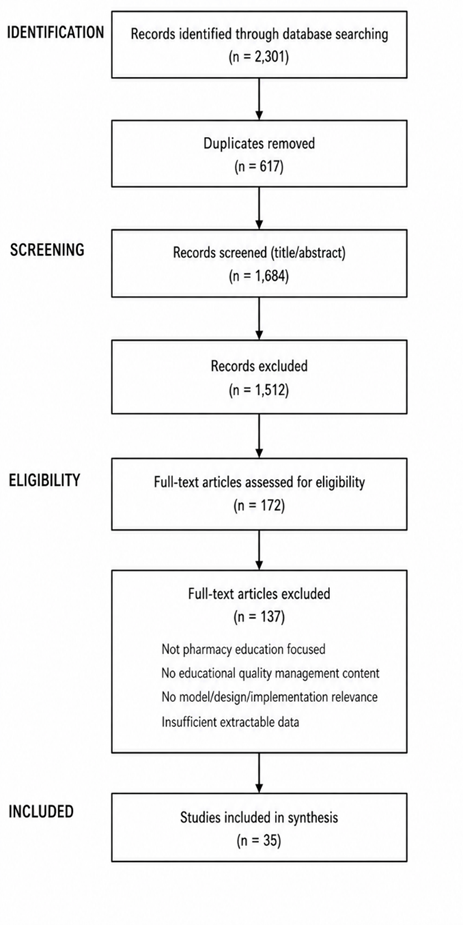
Records identified through database searching and hand-searching were exported into a reference-management system, deduplicated, and screened in two stages. First, titles and abstracts were assessed against the eligibility criteria to remove records that clearly did not address pharmacy education, educational management, curriculum quality, accreditation, assessment systems, or implementation. Second, full texts of potentially eligible records were assessed to determine whether they contained sufficient information about quality-oriented educational management design, implementation, evaluation, or conceptualization. Studies were selected for final synthesis only when their contribution could be mapped to one or more review domains, such as curriculum alignment, continuous improvement, accreditation integration, stakeholder governance, faculty engagement, or competency-based implementation. During the identification stage, 2,301 records were retrieved from database searching and supplementary hand-searching. After duplicate removal, 1,684 records proceeded to title and abstract screening, of which 1,512 were excluded because they were outside the review scope. A total of 172 full-text articles were assessed for eligibility, and 137 were excluded because they did not focus on pharmacy education, did not address educational quality management, lacked a relevant model or implementation component, or did not provide extractable data. The final synthesis included 35 peer-reviewed publications published between 2017 and 2025.
Figure 1 presents the PRISMA 2020 flow diagram summarizing the study identification, screening, eligibility assessment, and inclusion process.
|
|
|
Figure 1. PRISMA 2020 Flow Diagram of Study Selection for Quality-Oriented Educational Management Models in Pharmacy Education |
Data extraction framework
Data extraction used a standardized charting framework designed to capture both descriptive and interpretive features of the included literature. Extracted data included bibliographic information, country or institutional context where available, article type, quality model or framework, educational management domain, design features, implementation strategies, stakeholder groups, reported outcomes, barriers, facilitators, and relevance to accreditation or continuous improvement. For curriculum-focused papers, extraction emphasized mapping processes, outcome alignment, assessment structures, and curriculum review mechanisms [4, 7, 14, 19-21]. For implementation-focused papers, extraction emphasized leadership, faculty engagement, change management, stakeholder participation, and institutionalization of quality processes [10, 16, 22-25].
Quality appraisal
The included studies were appraised using design-sensitive criteria because the review corpus included heterogeneous publication types rather than one uniform study design. Empirical studies were assessed for clarity of aims, appropriateness of design, transparency of methods, adequacy of data sources, relevance of findings, and transferability to pharmacy education quality management. Program descriptions and curriculum reports were assessed for clarity of institutional context, explicitness of the quality-management process, description of implementation steps, use of evidence, and discussion of limitations. Reviews and conceptual papers were assessed for clarity of scope, relevance to pharmacy education, methodological transparency, and contribution to understanding quality-oriented educational management [17, 25-27]. Because the available literature is largely descriptive, appraisal focused on credibility, relevance, transparency, and practical transferability rather than statistical strength.
Synthesis method
The synthesis used thematic analysis to integrate findings across diverse study designs and publication types. Deductive themes were derived from the review question and included curriculum alignment, outcome mapping, accreditation integration, continuous improvement, assessment systems, stakeholder governance, faculty engagement, leadership, implementation barriers, and facilitators. Inductive themes were added where the literature revealed recurring issues, such as curricular overload, hidden curriculum, readiness for experiential learning, and the need to simplify overlapping outcome frameworks [20, 27-30]. Because the evidence was not sufficiently homogeneous for meta-analysis, findings were synthesized conceptually using cautious language such as “the literature suggests,” “studies describe,” and “evidence tends to indicate.” Table 1 illustrated inclusion and exclusion criteria.
|
Table 1. Systematic Review Inclusion and Exclusion Criteria |
||
|
Review element |
Inclusion criteria |
Exclusion criteria |
|
Time window |
Peer-reviewed publications from 2017 to 2025 |
Publications outside 2017–2025 |
|
Field |
Pharmacy education, PharmD education, undergraduate pharmacy education, pharmacy curriculum, pharmacy experiential education |
Non-pharmacy education unless directly relevant as background to pharmacy education quality management |
|
Topic |
Quality-oriented educational management, accreditation, continuous improvement, curriculum mapping, assessment systems, competency-based education, stakeholder governance, faculty engagement, implementation |
Clinical quality improvement without educational management focus |
|
Article type |
Empirical studies, mixed-methods studies, qualitative studies, curriculum reports, program descriptions, scoping reviews, systematic reviews, conceptual papers |
Editorials, opinion pieces without substantive model content, conference abstracts without full text |
|
Model relevance |
Explicit or functional description of a quality-management model, framework, tool, process, or implementation strategy |
Papers that mention quality only generally without design, implementation, or evaluation content |
|
Language |
English |
Non-English publications |
|
Evidence use |
Studies with extractable information on design features, implementation processes, outcomes, barriers, or facilitators |
Studies without extractable information relevant to the review framework |
Conceptualizations of quality and management in pharmacy education
Definitions and frameworks for quality
The reviewed literature conceptualizes quality in pharmacy education as a multidimensional construct that includes accreditation compliance, competency achievement, curricular coherence, assessment quality, stakeholder engagement, and the institutional capacity for continuous improvement. Rather than treating quality as a single outcome, program-quality scholarship emphasizes the difficulty of defining PharmD quality in a way that captures the interaction between educational processes, institutional resources, assessment systems, and graduate preparedness [2]. Competency-based education literature extends this view by framing quality around the explicit articulation, teaching, assessment, and demonstration of professional capabilities expected of pharmacy graduates [3, 17]. From this perspective, a high-quality pharmacy program is not only one that covers required content, but one that can show how learners progressively develop the knowledge, skills, behaviors, and judgment required for practice. Assessment-focused work further adds that quality depends on whether educational evidence is meaningful, interpretable, and useful for decision-making, rather than merely collected for reporting purposes [5, 11]. Across these studies, quality is best understood as a managed relationship among standards, outcomes, evidence, stakeholder expectations, and institutional improvement.
Typologies of management models
The literature suggests several overlapping typologies of quality-oriented educational management models in pharmacy education, each emphasizing a different mechanism for organizing educational quality. Accreditation-based models organize quality work around external standards, institutional self-study, documentation of compliance, and evidence of program enhancement, making accreditation a central structure for educational management [6, 8]. Curriculum-alignment models focus on the internal coherence of the program by using mapping and assessment design to connect outcomes, course content, learning activities, competency expectations, institutional missions, and national or professional requirements [4, 7, 17, 19]. Continuous-improvement models emphasize recurring feedback cycles, faculty engagement, interpretation of evidence, and iterative revision of educational processes, particularly through tools such as curriculum quality surveys and structured faculty dialogue [13, 16]. These typologies are analytically distinct, but in practice they often overlap because accreditation expectations require evidence, evidence depends on assessment and mapping systems, and improvement depends on faculty and stakeholder participation. The literature therefore indicates that quality-oriented educational management in pharmacy education is rarely a single model; it is more often a hybrid system combining standards-based accountability, outcome alignment, assessment evidence, and continuous improvement.
Degree of integration with accreditation requirements
Accreditation is a major driver of quality-oriented educational management in pharmacy education because it establishes formal expectations for curriculum coherence, student development, assessment, experiential learning, interprofessional education, and continuous improvement. Studies of ACPE standards, accredited Doctor of Pharmacy co-curricula, interprofessional education requirements, and Standards 2025 preparation show that accreditation frequently shapes the design of internal quality systems, including how programs document outcomes, organize curricular evidence, and demonstrate student development beyond classroom instruction [8, 10, 21, 31]. The literature suggests that accreditation-related quality management is strongest when standards are treated not simply as compliance requirements but as prompts for systematic curriculum review, stakeholder engagement, and evidence-informed decision-making. In this sense, accreditation can function as both an external accountability mechanism and an internal framework for organizing continuous educational improvement. However, the reviewed studies also imply that accreditation-driven systems may become overly procedural if institutions focus primarily on documentation rather than learning, interpretation, and change. A mature quality-oriented management model therefore uses accreditation as a foundation while extending beyond periodic review toward ongoing institutional learning and curriculum refinement.
Design features of quality-oriented educational management models
Curriculum alignment and outcome mapping
Curriculum alignment and outcome mapping are among the most frequently described design features of quality-oriented educational management in pharmacy education because they make the structure and intent of the curriculum visible. Mapping studies show how programs connect learning outcomes, competency frameworks, course content, assessments, institutional missions, and national requirements into a transparent curriculum structure that can be reviewed and improved [4, 7]. More focused mapping work demonstrates how specific competency domains, such as prescribing or course-level assessment outcomes, can be examined for coverage, sequencing, alignment, and assessment within accredited pharmacy programs [14, 19]. These approaches help institutions identify curricular gaps, unnecessary duplication, misalignment between teaching and assessment, and areas where expected competencies may not be sufficiently supported. In this way, mapping functions not only as a technical documentation tool but also as a quality-management mechanism that supports collective curriculum interpretation and evidence-informed decision-making. The reviewed literature therefore positions curriculum alignment as a foundational design feature because other quality processes, including assessment, accreditation review, and continuous improvement, depend on a clear understanding of how the curriculum is organized.
Continuous improvement cycles
Continuous improvement is commonly represented in the literature through recurring processes for gathering evidence, interpreting findings, making decisions, and revising educational structures. Experiential quality assurance studies show that improvement processes can be embedded in practice-based learning environments, where program quality depends on coordination among schools, preceptors, students, and experiential education administrators [9]. Curriculum quality survey studies demonstrate how feedback systems can support ongoing program review by giving institutions structured evidence about curriculum strengths, weaknesses, and areas requiring attention [13]. Faculty engagement models further show that continuous improvement requires more than data collection; it requires structured opportunities for academic staff to interpret evidence, discuss implications, and participate in decisions about change [16]. Design-thinking approaches to curricular revision similarly reflect an iterative process of problem identification, stakeholder input, solution development, and responsive redesign rather than a one-time reform event [32]. Across these studies, continuous improvement is presented as a practical cycle of evidence use and institutional learning, linking quality assurance with active educational management.
Stakeholder governance structures
Stakeholder governance is central to quality-oriented educational management because pharmacy education quality is shaped by multiple groups, including faculty, students, administrators, preceptors, practice partners, employers, and accreditation stakeholders. Co-curricular implementation studies show that quality systems must coordinate student development activities that occur beyond formal classroom instruction, requiring clear responsibility, communication, and evidence collection across different parts of the program [10]. Faculty engagement work highlights the importance of participatory structures that allow educators to understand quality evidence, deliberate collectively, and contribute to improvement decisions rather than simply receiving top-down directives [13]. Studies of experiential interprofessional education and cocurricular learning further indicate that student and practice-site perspectives are essential for evaluating whether quality systems are responsive to real educational experiences and professional practice expectations [33, 34]. Effective stakeholder governance therefore depends on creating formal and informal mechanisms through which evidence from different groups can be heard, interpreted, and translated into action. The reviewed literature suggests that quality-oriented models are more likely to be sustained when stakeholders see themselves as contributors to educational improvement rather than as subjects of monitoring or compliance.
Implementation strategies and processes
Leadership and institutional commitment
Implementation of quality-oriented educational management models in pharmacy education depends heavily on visible institutional commitment, because quality systems require authority, coordination, and sustained use of evidence in decision-making. Accreditation-oriented work shows that schools often organize quality activity around formal standards, self-study expectations, and leadership-driven preparation for program review [6, 8, 21]. Studies addressing curricular outcomes and framework integration also suggest that institutional leaders play an important role in reducing fragmentation when multiple outcome frameworks, assessment expectations, and accreditation demands compete for attention [28]. In this literature, leadership is not presented merely as administrative support but as the mechanism through which quality management becomes embedded in governance, resource allocation, and curricular accountability.
Faculty development and engagement
Faculty development and engagement are repeatedly described as necessary for implementing quality-oriented educational management, because faculty members translate quality frameworks into course design, assessment practice, student feedback, and curriculum revision. Studies of town hall engagement and curriculum quality survey use show that faculty participation is strengthened when quality data are discussed collectively and linked to meaningful program decisions [13, 16, 23]. Competency-based education literature also indicates that faculty need shared understanding of outcomes, entrustment, assessment expectations, and implementation processes before a model can operate consistently across a curriculum [17, 25]. The reviewed literature therefore suggests that faculty development should address both technical skills and cultural readiness for continuous improvement.
Phased rollout and change management
Phased rollout is a common implementation logic in pharmacy education because quality-oriented models often require changes to curriculum structures, assessment systems, committee responsibilities, and faculty work patterns. Studies of co-curriculum implementation and implementation challenges show that programs frequently need iterative clarification of expectations, documentation processes, and responsibilities before a new quality component becomes routine [10, 22]. Curriculum revision literature similarly describes change as a managed process involving diagnosis of curricular overload, redesign of learning experiences, and staged implementation rather than immediate system-wide transformation [20, 30, 32]. These studies indicate that change management in pharmacy education quality systems depends on communication, piloting, feedback, and gradual normalization of new practices.
Outcomes and impact on pharmacy education quality
Student learning outcomes and competency achievement
The reviewed literature links quality-oriented educational management to student learning mainly through competency alignment, assessment coherence, and readiness for professional practice, rather than through direct experimental claims. Studies of prescribing competency mapping, Pharmacist Patient Care Process integration, and APPE readiness assessment show how programs use structured frameworks to examine whether learners are being prepared for expected professional tasks [14, 15, 29]. Work on standardized curriculum outcomes assessment and assessment-practice quality further suggests that student learning evidence can inform program review when interpreted as part of a broader quality system [11, 12]. Overall, the literature tends to indicate that quality-management models support competency achievement by making expectations, assessment evidence, and curricular decision-making more explicit.
Program accreditation and stakeholder satisfaction
Program accreditation and stakeholder satisfaction are described as important areas of impact, but the literature is cautious about attributing outcomes directly to single quality-management interventions. Accreditation-focused studies show that standards can guide curriculum design, student development, interprofessional education, and preparation for new accreditation expectations [6, 8, 21, 31]. Studies of cocurricular learning, experiential interprofessional education, and curriculum quality surveys also indicate that student, faculty, and practice-site perspectives can provide valuable evidence about how quality systems are experienced by stakeholders [13, 33, 34]. The evidence therefore supports the role of quality-oriented educational management in strengthening accreditation readiness and stakeholder responsiveness, while direct causal claims remain limited.
Barriers and facilitators to implementation
Organizational and cultural barriers
Organizational and cultural barriers are prominent across the literature because quality-oriented educational management often requires changes in routines, authority, documentation, and shared assumptions about educational responsibility. Studies of co-curriculum implementation challenges show that ambiguity in expectations, workload demands, and coordination across program components can complicate implementation [22]. Work on curricular overload and content-management tools indicates that programs may struggle when accumulated content, competing priorities, and insufficiently coordinated review processes make quality improvement difficult to operationalize [20, 30]. Faculty engagement studies further suggest that resistance can arise when quality processes are perceived as compliance exercises rather than as meaningful mechanisms for educational improvement [16, 23].
Facilitators and success factors
Facilitators of implementation include leadership commitment, clear alignment with accreditation requirements, faculty engagement, stakeholder participation, usable evidence systems, and early opportunities to demonstrate value. Studies of curriculum quality survey improvement and town hall engagement suggest that transparent discussion of quality evidence can build shared ownership and make improvement processes more actionable [16, 23]. Competency-based implementation literature further indicates that shared language, faculty preparation, and alignment between outcomes and assessment are important for moving from conceptual endorsement to practical adoption [17, 24, 25]. Across the reviewed studies, successful implementation appears more likely when quality management is integrated into ordinary curriculum governance rather than added as a separate administrative burden.
Table 2 synthesizes the key implementation strategies, barriers, and facilitators that shape the effectiveness of quality-oriented educational management models in pharmacy education.
|
Table 2. Synthesis of Implementation Strategies, Barriers, and Facilitators in Quality-Oriented Educational Management Models |
||||
|
Domain |
Implementation Strategies |
Common Barriers |
Key Facilitators |
Implications for Practice |
|
Leadership & Governance |
Strategic alignment, accreditation-driven oversight |
Weak institutional commitment |
Strong leadership visibility |
Embeds quality into institutional decision-making |
|
Faculty Engagement |
Training, collaborative review, data interpretation |
Resistance, workload burden |
Participatory culture, shared ownership |
Enables sustainability of quality systems |
|
Curriculum Systems |
Mapping, alignment, structured assessment |
Fragmentation, duplication |
Integrated curriculum frameworks |
Improves coherence and transparency |
|
Continuous Improvement |
Feedback loops, quality surveys, review cycles |
Data fatigue, lack of interpretation |
Usable evidence systems |
Transforms data into actionable decisions |
|
Change Management |
Phased rollout, pilot testing, iterative refinement |
Implementation complexity |
Gradual normalization of processes |
Supports long-term adoption |
|
Stakeholder Integration |
Inclusion of students, preceptors, partners |
Coordination challenges |
Multi-level governance structures |
Enhances relevance and responsiveness |
Quality appraisal and synthesis of included studies
Critical appraisal of study quality
Critical appraisal showed that the included literature was suitable for thematic synthesis but limited for causal inference. Curriculum mapping, accreditation, assessment, and quality survey studies generally provided useful detail about model components, institutional processes, and evidence systems, but many were descriptive and context-specific [4, 7, 13, 14, 19, 21]. Implementation-focused studies offered practical insight into faculty engagement, co-curriculum development, curricular revision, and competency-based change, although they often relied on local experience, self-report, or program-level documentation rather than controlled comparisons [10, 16, 22, 24, 25, 30, 32]. Reviews and conceptual papers strengthened the synthesis by clarifying broader themes, but the overall evidence base remains better suited to identifying design and implementation patterns than to determining effectiveness.
Thematic synthesis and findings
Thematic synthesis identified quality-oriented educational management as an integrated system involving curriculum alignment, competency mapping, accreditation integration, assessment evidence, stakeholder governance, faculty engagement, and continuous improvement. Mapping and assessment-alignment studies contributed most directly to the design theme by showing how outcomes, content, assessments, and standards can be made visible for review [4, 7, 14, 19]. Experiential education, co-curriculum, APPE readiness, and interprofessional education studies showed that quality management must extend beyond classroom-based curriculum into practice-based and developmental learning environments [7, 10, 29, 33, 31]. Faculty engagement, implementation science, and competency-based education studies clarified that models become functional only when evidence systems are connected to leadership, faculty development, communication, and institutional decision-making [16, 17, 24, 25].
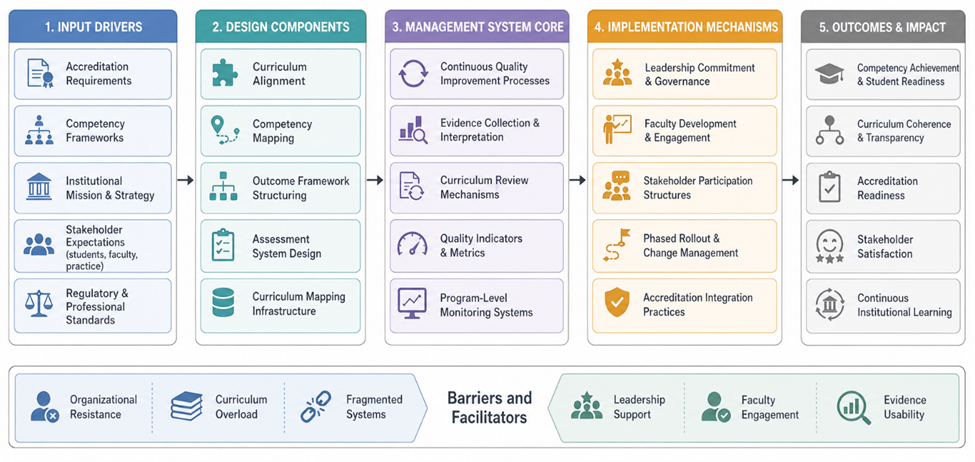
Figure 2 illustrates the integrated system architecture linking design components, implementation mechanisms, and educational outcomes in quality-oriented educational management models in pharmacy education.
|
|
|
Figure 2. Integrated Architecture of Design and Implementation of Quality-Oriented Educational Management Models in Pharmacy Education |
Assessment of publication bias and evidence strength
The strength of the evidence is limited by likely publication bias toward successful, innovative, or accreditation-responsive initiatives. The literature contains many accounts of curriculum tools, mapping processes, quality surveys, co-curricular structures, and implementation strategies, but fewer reports of unsuccessful implementation, abandoned models, or long-term sustainability problems [10, 13, 20, 22, 23, 30]. This creates a risk that the published literature overstates feasibility and underrepresents organizational resistance, resource constraints, and implementation fatigue. Consequently, the findings of this review should be interpreted as a synthesis of reported design and implementation patterns rather than definitive evidence that any single model reliably improves educational outcomes.
Limitations
Limitation of the primary studies
Most included studies were descriptive, single-site, or focused on specific components such as curriculum mapping, assessment, co-curriculum, experiential education, or curricular revision [7, 9, 10, 30]. This limits generalizability across institutional, national, and accreditation contexts. Although several papers offered useful tools and models, few included long-term follow-up, comparative designs, or independent evaluation of sustainability [13, 29, 20]. The evidence therefore provides practical insight into quality-system design, but weaker support for long-term educational impact.
Limitations of the review process
This review was limited to English-language peer-reviewed publications from 2017 to 2025, which may have excluded relevant institutional reports, accreditation documents, local quality manuals, and non-English studies. The search also depended on explicit or functional links to educational quality, curriculum management, accreditation, competency-based education, or continuous improvement, so studies using different terminology may have been missed [1, 4, 6, 17]. As a result, the synthesis should be read as a structured account of accessible peer-reviewed evidence, not a complete map of all quality-management practice in pharmacy education.
Conclusion
Quality-oriented educational management models in pharmacy education are integrated systems connecting curriculum design, assessment evidence, accreditation expectations, stakeholder governance, and continuous improvement. Rather than relying on a single universal model, pharmacy schools commonly combine mapping tools, competency frameworks, assessment processes, review structures, and feedback mechanisms.
The strongest design features identified in this review are curriculum alignment, outcome mapping, continuous improvement cycles, and stakeholder governance. Implementation depends on leadership commitment, faculty engagement, phased change, and integration with routine accreditation and curriculum processes.
Important gaps remain. More longitudinal, comparative, and multi-institutional studies are needed to examine how quality-management models develop over time and influence educational decision-making beyond accreditation preparation.
For pharmacy school administrators, quality management should be designed as a coherent institutional system rather than a collection of disconnected tools. For researchers, clearer reporting standards would improve comparability across studies and strengthen future reviews of educational quality-management interventions.
Acknowledgments: None
Conflict of interest: None
Financial support: None
Ethics statement: None
References
- Cooley J, Stolpe SF, Montoya A, Walsh A, Hincapie AL, Arya V, et al. An analysis of quality improvement education at US colleges of pharmacy. Am J Pharm Educ. 2017;81(3):51.
- Mattingly TJ II, Romanelli F, Cain J, Schlesselman LS. Measuring up–defining the quality of PharmD programs. Am J Pharm Educ. 2017;81(9):6071.
- Koster A, Schalekamp T, Meijerman I. Implementation of competency-based pharmacy education (CBPE). Pharmacy. 2017;5(1):10.
- Gmeiner T, Horvat N, Kos M, Obreza A, Vovk T, Grabnar I, et al. Curriculum mapping of the master’s program in pharmacy in Slovenia with the PHAR-QA competency framework. Pharmacy. 2017;5(2):24.
- Poirier TI, Wilhelm M. Scholarly and best practices in assessment. Am J Pharm Educ. 2018;82(3).
- Alkhateeb FM, Arkle S, McDonough SL, Latif DA. Review of national and international accreditation of pharmacy programs in the Gulf Cooperation Council countries. Am J Pharm Educ. 2018;82(10):5980.
- Önen Bayram FE, Köksal M. A quantitative curriculum mapping of the faculty of pharmacy of Yeditepe University, Turkey: a process to assess the consistency of a curriculum with the mission and vision of an institution and national requirements. Pharmacy. 2019;7(3):78.
- Evans RL, Duncan W, Jungnickel PW. Incorporating ACPE standards in a holistic approach to school operations and accreditation. Am J Pharm Educ. 2019;83(3):7073.
- Assemi M, DiVall MV, Lee K, Sy E, O’Sullivan T. Quality assurance and improvement practices of experiential education programs in schools of pharmacy. Am J Pharm Educ. 2019;83(3):6582.
- Maerten-Rivera JL, Chen AM, Augustine J, d’Assalenaux R, Lee KC, Lindsey CC, et al. Co-curriculum implementation and assessment in accredited doctor of pharmacy programs. Am J Pharm Educ. 2020;84(3):7569.
- Janke KK, Kelley KA, Martin BA, Ray ME, Sweet BV. Identifying high-impact and managing low-impact assessment practices. Am J Pharm Educ. 2019;83(7):7496.
- Sweet BV, Assemi M, Boyce EG, DiVall MV, Garavalia LS, Gortney J, et al. Characterization of use of the pharmacy curriculum outcomes assessment across accredited colleges of pharmacy. Am J Pharm Educ. 2019;83(7):7091.
- Meny L, Seiferlein M, Chen AM, Maerten-Rivera J, Pavuluri N, Behnen EM, et al. Administration and evaluation of the American Association of Colleges of Pharmacy curriculum quality surveys in pharmacy schools. Am J Pharm Educ. 2021;85(3):8045.
- Abdallah O, Ageeb RA, Elkhalifa WH, Zolezzi M, El-Awaisi A, Diab MI, et al. Evaluating prescribing competencies covered in a Canadian-accredited undergraduate pharmacy program in Qatar: a curriculum mapping process. BMC Med Educ. 2020;20(1):253.
- Chen AM, DiVall MV, Gonyeau MJ, Kiersma ME, O’Sullivan TA, Conway JM, et al. Curricular inclusion of pharmacist patient care process in the US PharmD programs. Am J Pharm Educ. 2021.
- Meny LM, Seiferlein MR, Chen AM. Faculty perceptions of a town hall model for engagement in continuous quality improvement. Curr Pharm Teach Learn. 2021;13(8):968-74.
- McMullen J, Arakawa N, Anderson C, Pattison L, McGrath S. A systematic review of contemporary competency-based education and training for pharmacy practitioners and students. Res Social Adm Pharm. 2023;19(2):192-217.
- Arakawa N, Bruno-Tomé A, Bates I. A global comparison of initial pharmacy education curricula: an exploratory study. Innov Pharm. 2020;11(1):10.24926/iip.v11i1.2093.
- Mejia AB, Singh L, Flank J, Sivakumaran G. Mapping course assessments to Canadian pharmacy educational outcomes to ensure pharmacy students’ practice readiness. Am J Pharm Educ. 2022;86(6):8724.
- Sobieraj DM, Chen AM, Luciano JL, Bechtol RA, Kelsch MP. Exploring tools to manage curricular content and overload within the professional PharmD program. Am J Pharm Educ. 2024;88(10):101276.
- Fulford MJ, Castleberry AN, Medina MS. A curricular assessment blueprint and needs analysis for the curricular outcomes and entrustable professional activities. Am J Pharm Educ. 2025;89(4):101378.
- Maerten-Rivera JL, Chen AM, Augustine J, d’Assalenaux R, Lindsey CC, Malcom DR, et al. Challenges to implementation of the co-curriculum in accredited pharmacy programs. Am J Pharm Educ. 2021;85(5):8301.
- Meny L, Maerten-Rivera J, Gettig JP, Goliak KL, Schwartz AH, Higginbotham M, et al. Moving AACP curriculum quality survey results from good to great. Am J Pharm Educ. 2023;87(3):ajpe9004.
- Chen AM, Kleppinger EL, Churchwell MD, Rhoney DH. Examining competency-based education through the lens of implementation science: a scoping review. Am J Pharm Educ. 2024;88(2):100633.
- Gavaza P, Kang G, Doloresco F, Kawahara N. Pharmacy faculty perspectives about implementing competency-based education in pharmacy education. Curr Pharm Teach Learn. 2025;17(5):102322.
- Nelson NR, Anderson SM, Zeeman JM, Rhoney DH. A scoping review of the pharmacy curriculum outcomes assessment literature. Am J Pharm Educ. 2021;85(8):8505.
- Park SK, Chen AM, Daugherty KK, Frankart LM, Koenig RA. A scoping review of the hidden curriculum in pharmacy education. Am J Pharm Educ. 2023;87(3):ajpe8999.
- Fulford MJ, DiVall MV, Darley A, Smith KM. A call for simplification and integration of doctor of pharmacy curricular outcomes and frameworks. Am J Pharm Educ. 2022;86(8):ajpe8931.
- VanLangen KM, Schmidt KJ, Sohn M, Meny LM, Bright DR. Development of an APPE readiness assessment plan: initial evaluation and next steps. Am J Pharm Educ. 2022;87(4):9002.
- Trujillo JM, Wettergreen SA, Bain DL. A doctor of pharmacy curriculum revision process focused on curricular overload. Am J Pharm Educ. 2024;88(8):100758.
- Zeeman JM, Vyas D, Ragucci KR. Best practices for interprofessional education to meet the curriculum outcomes and entrustable professional activities. Am J Pharm Educ. 2024;88(12):101321.
- Sobieraj DM, Wheeler K, Salvo M, Smith M. Prescription for curricular revision: application of design thinking principles. Am J Pharm Educ. 2024;88(12):101325.
- Depasquale C, Arnold A, Cunningham S, Jacob SA, Boyter A, Portlock J, et al. Exploring structures and processes supporting interprofessional education during experiential learning placements for student pharmacists. Am J Pharm Educ. 2024;88(10):101267.
- Williams VL, Haddad M, Kelley KA, Li J, Rodis JL. Evaluation of cocurricular learning and the influence of student choice. Am J Pharm Educ. 2024;88(9):101257.
How to cite this article:
Citation Formats:
Contact Meral
Meral Publications
www.meralpublisher.com
Davutpasa / Zeytinburnu 34087
Istanbul
Turkey
Email: [email protected]